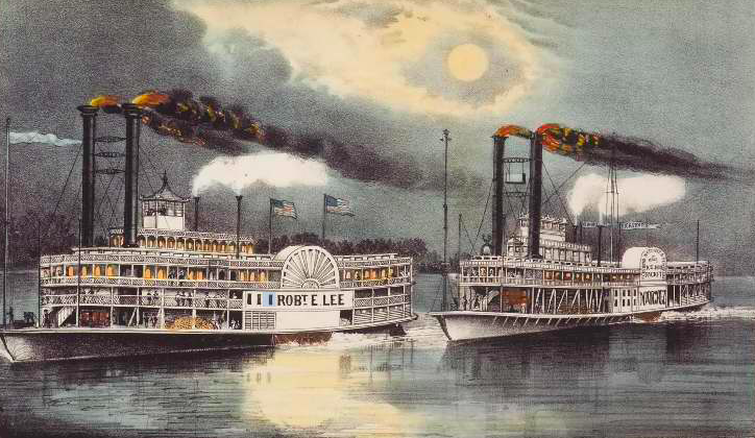
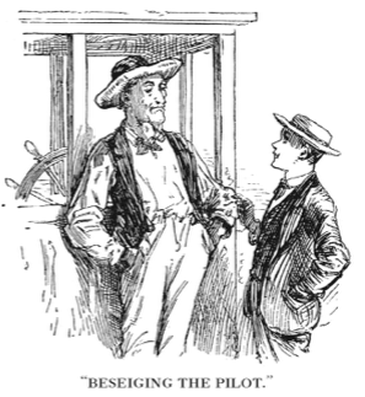
 Illustration from Twain's book "Life on the Mississippi" published in 1885. 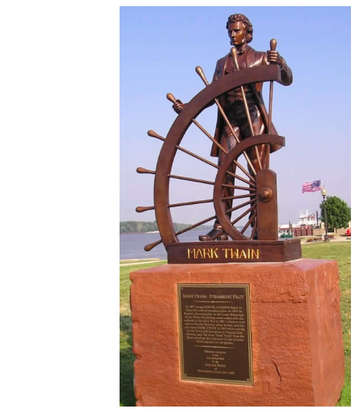 Monument to Mark Twain on riverfront of Hannibal, Missouri. Monument to Mark Twain on riverfront of Hannibal, Missouri. Roger McCoy
Many boys in the nineteenth century watched riverboats coming and going and held the dream of becoming a boat pilot. Just as today a child might dream of becoming a railroad engineer or an airplane pilot, young boys then wanted the glamorous and prestigious job of steering a riverboat. The only way to achieve this dream was to start as a cub (apprentice) in one of the other jobs and eventually become a cub pilot. This usually required convincing a current boat pilot to take on teaching a young man to handle the boat. The best known account of learning to be a riverboat pilot comes from Samuel Clemens who worked on a riverboat and eventually convinced the boat’s pilot to take him on as a cub pilot. His original intention was to travel down the river to New Orleans and find a ship headed to the Amazon River. He soon discovered that no ship was likely to head for the Amazon for ten or twelve years and that his remaining ten dollars was insufficient for his plan. Clemens resolved to give up the idea of becoming an Amazon explorer and “contrive a new career.” He later wrote, “When I was a boy, there was but one permanent ambition among my comrades in our village on the west bank of the Mississippi River. That was, to be a steamboatman.” !n 1857 the twenty-one year-old Clemens was traveling on the steamboat Paul Jones and he worked up an acquaintance with the pilot. “I planned a siege against my pilot, and at the end of three hard days he surrendered. He agreed to teach me the MIssissippi River from New Orleans to St. Louis for five hundred dollars [equivalent to $19,000+ today], payable out of the wages I should receive after graduating. I entered upon the enterprise of learning twelve or thirteen hundred miles of the great Mississippi River with the easy confidence of my time of life. I supposed that all a pilot had to do was to keep his boat in the river, and I did not consider that could be much of a trick, since it was so wide.” After four hours into his first voyage Clemens’ chief suddenly said, “Here you take her; shave those steamships as close as you’d peel an apple.” The young Clemens’ heart “fluttered up into the hundreds for it seemed we were about to scrape the side off every ship on the line we were so close.” After a few tense minutes of seeming peril, the chief pilot “flayed me alive for my cowardice” because Clemens had been overly cautious near the other boats. Clemens admitted his admiration for the ease the pilot showed in handling the boat, and after the pilot’s temper cooled a bit he resumed his instruction of the young cub. The pilot told Clemens, “the easy water was close ashore and the current outside, and therefore we must hug the bank, up-stream and stay well out, down-stream.” At that point Clemens resolved that he would be a down-stream pilot and leave the up-streaming to people with no concern for risk. At the end of his first watch the young Clemens ate supper and went to bed. At midnight his next watch began with the night watchman shining a lantern in Clemens’ eyes with the harsh words, “Come! Turn out!” Clemens dozed off to sleep as soon as the watchman left. The man with the lantern soon returned and was by now distinctly annoyed at Clemens’ disobedience. Clemens was further embarrassed by jeers of the previous watch just turning in. “Hey watchman! ain't the new cub turned out yet? He's delicate, likely. Give him some sugar in a rag and send for the chambermaid to sing rock-a-by-baby to him.” [NOTE: In the nineteenth century fussy babies were given a bit of sugar tied into the corner of a rag giving rise to the term “sugar tit.”] Clemens reluctantly realized that a pilot needing to get up in the middle of the night was a detail of the job that had never occurred to him. He knew that boats ran all night but had never realized “that somebody had to get up out of a warm bed to run them.” On his midnight watch Mr Bixby, the pilot began to question Clemens about the names of shoreline features and Clemens had no answers. As it turned out this was the information Bixby had been telling the previous day to teach him the river. Finally the exasperated Bixby said in an unusually calm manner, “My boy, you must get a little memorandum book, and every time I tell you a thing, put it down right away. There's only one way to be a pilot, and that is to get this entire river by heart. You have to know it just like ABC.” Clemens wrote that he soon realized, I have not only to get the names of all the towns and islands and bends, and so on, by heart, but I must even get up a warm personal acquaintanceship with every old snag and one-limbed cotton-wood and obscure wood pile that ornaments the banks of this river for twelve hundred miles; and more than that, I must actually know where these things are in the dark. This indeed was the crux of being a pilot on a Mississippi River boat. Another nineteenth century pilot and writer, George Merrick, confirmed Clemens’ observation with the comment: To know the river under those conditions meant to know absolutely the outline of every range of bluffs and hills, as well as every isolated knob or even tree-top. It meant that the man at the wheel must know these outlines absolutely, under the constantly changing point of view of the moving steamer; so that he might confidently point his steamer at a solid wall of blackness, and guided only by the shapes of distant hills, and by the mental picture which he had of them, know the exact moment at which to put his wheel over and sheer his boat away from an impending bank. Clemens’ chief pilot, Bixby, was later assigned to a different, bigger and more luxurious boat and Clemens went with him. He was beginning to understand the complexities of being a riverboat pilot. After two years as apprentice the young man named Samuel Clemens received his steamboat pilot’s license. Then he began piloting boats on his own for two years, until the Civil War halted steamboat traffic. During his time as a pilot, he picked up the term “Mark Twain,” a boatman’s call noting that the river was only two fathoms deep, the minimum depth for safe navigation. When Clemens returned to writing in 1861, working for the Virginia City Territorial Enterprise, he wrote a humorous travel letter signed by “Mark Twain” and continued to use the pseudonym for nearly 50 years. Sources: https://www.history.com/this-day-in-history/mark-Clemens-receives-steamboat-pilots-license http://www.twainquotes.com/Steamboats/Introduction.html Clemens, Samuel L. 1885. Life on the Mississippi. retrieved from: Gutenberg Books, <https://www.gutenberg.org/cache/epub/245/pg245-images.html#linkc6> Merrick, G. B. 1909. Old Times on the Upper Mississippi: Recollections of Steamboat Pilot from 1854 to 1863. Cleveland: Arthur H. Clark Company: Ohio.
2 Comments
Michael Dalton McCoy
3/17/2023 12:00:29 pm
Makes me want to boat down a river, not necessarily the driver though. Nicely written, thanks!
Roger
3/18/2023 11:15:16 am
You took a canoe. Not quite the same, but still a good adventure. Leave a Reply. |
Archives
April 2023
Categories
|
 RSS Feed
